
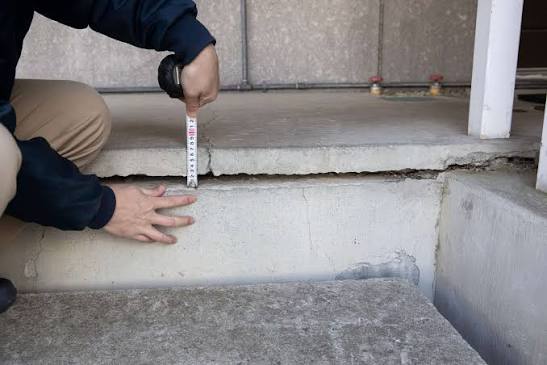

Why electrical resistivity tomography and targeted ground testing can make resin injection a measured engineering intervention rather than a blind repair
A diagonal crack above a window may be the first visible sign of subsidence, but it is not a diagnosis. The same is true of a sticking door, a sloping floor or a gap beside a skirting board. Each records movement in the building. None, on its own, explains what has changed in the ground beneath it.
That distinction matters because foundation repair is only as reliable as the ground model on which it is based. Clay shrinkage, leaking drains, poorly compacted fill, washout and localised voiding can produce similar damage at the surface while requiring different treatment below it. A contractor who starts with a repair method and works backwards risks treating the symptom rather than the mechanism.
In this context, GEOSEC combines electrical resistivity tomography (ERT), direct ground testing and controlled expanding resin injection as part of its approach to subsidence repair. The purpose is straightforward: investigate the affected volume, target the intervention and check how the ground responds while work is under way.
The crack is evidence rather than an explanation
Subsidence describes downward ground movement that affects the support provided to a building. Settlement is often used for movement caused by compression under load, while heave describes upward movement. On a real property, more than one process may be present and the pattern may not be uniform.
Shrinkable clay is a familiar UK mechanism. The British Geological Survey notes that swelling clays can change volume as moisture conditions vary, with resulting ground movement capable of affecting foundations. Trees, prolonged dry periods and leaking water services may alter the local moisture regime, but their relevance has to be established at the individual site.
In granular fill, the more immediate concern may instead be poor compaction, migration of fines or an unrecorded void.
The structural survey and drainage information therefore remain essential. Crack geometry, foundation arrangement, construction history and any monitoring data help define the problem. The ground investigation then tests the assumptions beneath that initial diagnosis.
What electrical resistivity tomography measures
ERT is a geophysical technique. A controlled electrical current is introduced into the ground through electrodes, while other electrodes measure the resulting differences in electrical potential. Repeating these measurements across many electrode combinations produces a large dataset from which the apparent electrical resistivity of the ground can be calculated.
The field readings do not form a ready-made picture of the soil. They are processed through an inversion procedure that estimates a resistivity distribution capable of explaining the measurements. The result is a two-dimensional or three-dimensional geo-electrical model of the investigated volume.
Resistivity is influenced by several variables, including soil type, porosity, degree of saturation, pore-water chemistry and the presence of air-filled voids. Wet fine-grained ground will usually behave differently from dry granular material, but a colour change on a resistivity section is not a direct measurement of bearing capacity. Interpretation needs geological judgement and site-specific calibration.
Why ERT needs direct ground testing
A reliable investigation combines the spatial coverage of geophysics with measurements that test the ground mechanically. GEOSEC uses dynamic probing, including DPM testing where appropriate, to investigate locations selected from the ERT model. These may include zones showing unusually high or low resistivity, abrupt lateral changes or anomalies beneath the affected foundations.
The two techniques answer different questions. ERT helps indicate where the ground differs and how far an anomaly may extend. Dynamic probing records resistance with depth at a specific location.
When the results are considered together, the engineer can refine the ground model and select the depth and distribution of the proposed resin injection points.
This correlation is especially important in made ground, where a single borehole or probing location may miss a nearby pocket of weak material. Conversely, ERT without calibration can overstate the certainty of an indirect measurement. The value lies in the combination.
How targeted resin injection changes the ground
Expanding resin is delivered through small-diameter injection tubes placed at the designed locations and depths. The liquid components react in the ground and increase in volume.
Depending on the soil, confinement and injection sequence, the resin may fill open voids, bind or displace weak material, form reinforcing lenses, or increase confinement and density around the treated zone.
The intervention is carried out in controlled stages rather than as a single large injection. Volumes, location, depth and the response of the structure or slab are monitored by the site team.
Where the design objective includes re-establishing contact beneath a foundation, the first measurable upward response can indicate that the expanding material has filled accessible voids and developed reaction against the structure. It is a control signal, not a substitute for engineering verification.
Because access is gained through relatively small holes, resin injection can provide a minimally disruptive alternative to excavation-based underpinning in suitable ground conditions. Occupation of the building may often continue, subject to the site-specific risk assessment and the location of the works.
Monitoring the intervention in four dimensions
GEOSEC’s See and Shoot procedure uses repeat ERT measurements during the injection programme. Comparing models acquired before, during and after treatment adds time as a fourth dimension.
The engineer can observe changes in the geo-electrical response across the treated volume and adjust subsequent injections where the evidence justifies it.
Increased resistivity in a treated area may be associated with displacement of pore water, a reduction in connected void space or the presence of cured resin. The interpretation still depends on the starting conditions.
A change in the ERT model shows that the electrical properties have changed; it does not, by itself, prove a specified bearing capacity.
Post-treatment dynamic probing can provide the complementary mechanical check. Comparing pre-treatment and post-treatment resistance at selected locations helps quantify improvement and test whether the design objective has been achieved.
Together, repeat ERT, probing data, injection records and level monitoring create an auditable account of the intervention.
When resin injection is not the whole answer
No responsible ground improvement contractor should present one method as universal. Resin injection is most persuasive where the mechanism, treatment depth and geometry can be defined and where improving the existing ground will restore adequate support.
Traditional underpinning, piles or driven micropiles may be more appropriate where loads must be transferred through a deep compressible sequence to a competent stratum, where the foundation itself is inadequate, or where a major change of use introduces new structural loads.
Drainage defects must be repaired before ground treatment if continuing leakage would recreate the problem. Masonry repairs should normally follow stabilisation, once the cause of movement has been addressed.
Some projects require a hybrid design. Resin injection may treat local voiding or loosened ground, while micropiles provide a defined load path for a heavily loaded element. The correct decision follows investigation; it should not be dictated by the equipment available on the day.
A more defensible route to foundation repair
For homeowners, insurers and structural engineers, the central question is not whether resin injection is faster than traditional underpinning. It is whether the proposed treatment matches the ground conditions and can be verified.
ERT-guided subsidence repair provides a way to move from visible damage to a spatial model of the ground, then from that model to a targeted intervention. Direct tests and monitoring place limits around the interpretation.
The result is a foundation repair strategy based on measured conditions rather than a standard injection pattern.
Cracks may bring the problem to attention. The engineering begins beneath them.
Frequently asked questions
What are the common signs of subsidence?
New diagonal or stepped cracks, sticking doors or windows and uneven floors can indicate movement. Similar symptoms can have other causes, so a professional assessment is needed before repair is specified.
Is resin injection the same as underpinning?
No. Resin injection improves or restores support within the existing ground. Underpinning and piling transfer structural loads through new foundation elements. Either may be appropriate depending on the mechanism, depth and loading.
Can ERT measure bearing capacity?
Not directly. ERT maps variations in electrical resistivity. Mechanical testing, such as dynamic probing, is used to calibrate the interpretation and assess changes in ground resistance.
Can the building remain occupied?
Often it can, because access holes and plant requirements are limited compared with excavation. The answer remains subject to the property layout, risk assessment and agreed method of work.
