
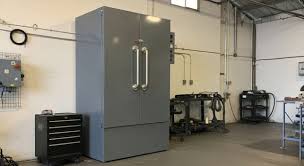

A well-engineered curing environment has a direct effect on whether a finish stays bonded through stress, vibration, and continuous use. Coating adhesion depends not only on chemistry but also on the stability of the oven carrying the load. An industrial curing oven built for heavy production cycles ensures coatings stay locked in place even under demanding conditions.
Uniform Heat Distribution Keeping Coating Bonds Stable Under Stress
Uniform heating allows coatings to form consistent molecular connections across every surface area. Industrial curing ovens accomplish this by circulating conditioned air evenly so that parts receive identical thermal exposure. Without this consistency, certain areas may soften or under-cure, causing adhesion loss later. The stability of the heat pattern becomes especially important under high load cycles, since large or dense batches absorb and deflect heat differently. A paint curing oven is engineered to counter this by maintaining balanced heat signatures, preventing weak spots that compromise durability.
Steady Airflow Preventing Cool Spots During High-volume Cycles
Reliable airflow ensures every coated part is met with the same temperature and air movement. This prevents cool pockets from forming behind large components or between closely spaced items. Industrial curing ovens use high-capacity blowers and directional ducting to keep the airstream consistent.
As product volume grows, airflow management becomes even more essential. Parts positioned throughout the chamber still receive proper curing conditions because the circulation design avoids stagnation that could interrupt coating adhesion.
Controlled Ramp Rates Reducing Shock to Freshly Applied Finishes
Controlled temperature increases protect fresh coatings from sudden thermal stress. A rapid rise in heat can cause bubbling, surface lift, or premature film stretch. Industrial curing ovens regulate these increases so the coating transitions gradually into its curing phase.
This approach supports adhesion by letting solvents and binders settle correctly before full heat exposure. Batch after batch, the oven’s control system keeps ramp rates predictable, which benefits any finish that relies on stable curing behavior.
Reinforced Chamber Designs Holding Temperature During Heavy Loads
Strong chamber construction helps prevent heat loss when large or dense loads draw energy away from the walls. Reinforced panels and sealed seams allow the oven to keep temperatures steady. A paint curing oven with a tight build maintains setpoints even when the chamber is filled to capacity. The stability of the structure limits fluctuations that could weaken coating bonds. Heavy-duty framing, secure door seals, and insulated wall panels play a direct role in preserving adhesion during continuous operations.
Balanced Part Spacing Avoiding Crowding That Disrupts Curing
Balanced spacing is essential because parts that touch or block airflow prevent coatings from curing uniformly. Industrial curing ovens are designed to accommodate various rack styles that help operators position items correctly. This spacing minimizes shadowed areas that otherwise cure slower.
Proper part arrangement becomes even more important under heavy loads, where curing space fills quickly. When items are placed with airflow paths in mind, coatings reach their intended hardness and adhesion strength without interference.
Consistent Dwell Timing Ensuring Coatings Reach Full Cross-link
Dwell time determines whether a coating cross-links to its full structural potential. Industrial curing ovens maintain this timing precisely, ensuring finishes remain inside the chamber long enough to achieve optimal bond integrity. Under-curing reduces adhesion, while overexposure can weaken the film.
Cycle after cycle, controllers keep dwell timing stable even as production demands rise. This allows each batch to receive the final cure needed to handle stress, abrasion, and long-term wear.
Precision Heaters Maintaining Setpoints Through Repeated Batches
High-quality heaters prevent temperature drift during repeated cycles. Industrial curing ovens rely on precision heating elements that respond quickly to load changes, keeping the environment at the programmed setpoint. These elements ensure coatings are never exposed to temperatures outside the required curing range.
Their responsiveness also supports adhesion across mixed part sizes. Whether curing small components or large assemblies, the oven maintains steady thermal conditions that protect the coating bond.
Robust Insulation Shielding the Chamber from Ambient Fluctuation
Insulation keeps outside temperatures from affecting curing performance. Industrial curing ovens with robust insulation maintain energy efficiency while holding consistent heat inside the chamber. This protects coatings from ambient shifts caused by seasonal changes or nearby equipment.
High-quality insulation also helps during continuous operation. Even as doors open for loading and unloading, the chamber recovers heat quickly, preserving the curing conditions needed for strong adhesion. Reliant Finishing Systems provides industrial curing ovens designed to support these performance requirements for businesses seeking dependable coating results.
